A Winter Garden Read Through Silhouette
A winter garden silhouette walk helps you read bare branches, spot crowded outlines, and decide which seasonal shapes deserve more breathing room.
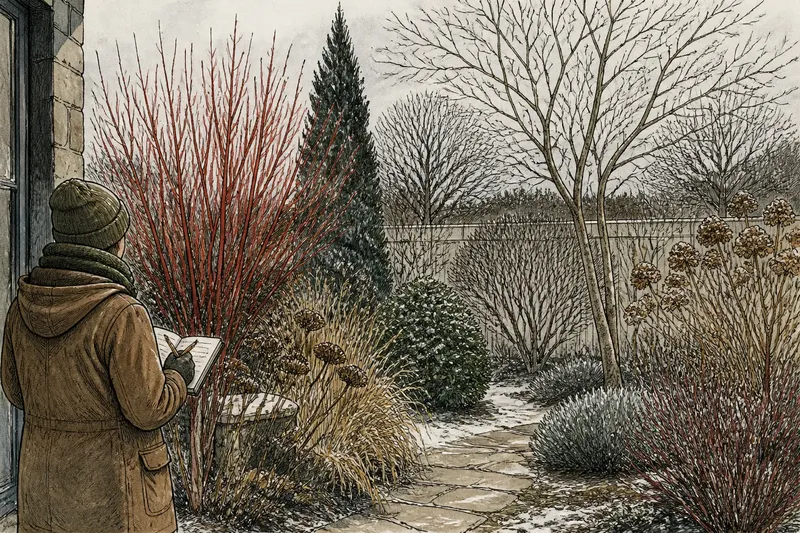
On a gray winter morning, a redtwig dogwood can look like a brushstroke against a fence, while a nearby shrub disappears into a tangle of twigs. A winter garden silhouette walk makes those differences easier to see: follow the outlines, notice where branches overlap, and read the garden’s composition when leaves and flowers no longer hold your attention.
This is not a pruning session disguised as a stroll. It is a way to observe plant forms at rest, identify what makes them legible or muddled, and choose a modest response for the coming season. Walk slowly, look from familiar spots, and resist the urge to fix every bare branch you notice.
Start with the whole outline
Begin at a window, doorway, or usual seating spot. Let your eyes take in the garden as a single arrangement before focusing on individual plants. The useful question is not simply which shrub looks attractive, but where its shape sits in relation to the house, fence, path, and neighboring plants.
Look for a clear outline, a break in the outline, or a place where several forms merge. A tall upright evergreen might make a strong vertical against a low spreading juniper; if both crowd the same patch of sky, their separate shapes may be hard to read.
Try changing your viewing position before deciding something is misplaced. A branch that appears tangled from the kitchen window may form a graceful arc from the garden gate.
When every branch tangles
What causes it: Several plants may have similar heights and branching habits, or their crowns may overlap at the most familiar viewing angle. Fine twigs can also visually blend with a busy fence, trellis, or thicket behind them.
What to try: View the plants against a different backdrop. A dark evergreen may show more clearly against a pale wall, while a delicate deciduous shrub may read better against open sky than against a lattice of branches.
Say you have a hazel and a viburnum that appear to form one dense mass from the patio. Imagine standing a few steps to the side and seeing the hazel’s angled stems separate from the viburnum’s rounded crown; the observable result is two distinct outlines without removing a branch. If the forms still merge from the places you use most, mark the overlap mentally and reconsider spacing or selective pruning after learning each plant’s growth habit.
When a plant disappears
What causes it: A fine-textured or low-contrast silhouette can fade into its background. Thin branches against a dark fence may vanish, and a dark evergreen against deep shade can lose its edges even when its overall form is sound.
What to try: Check the same plant against more than one background and at different times of day. Notice whether the outline appears in side light, against the sky, or from a window with a lighter view behind it. That observation can help distinguish a visibility problem from a plant whose shape is genuinely obscured by neighbors.
You can also notice where winter light falls without moving the plant. A stem that catches low sun may contribute a brief, crisp line; another may be most readable against snow or a pale wall. Treat those contrasts as seasonal features, not as a requirement for every plant to stand out from every viewpoint.
When the garden feels flat
What causes it: Bare borders can seem like a single horizontal band when plants share similar heights, or when the view contains no clear transitions from low forms to upright ones. The issue may be the arrangement of outlines rather than a lack of evergreen foliage.
What to try: Scan for changes in direction and scale: a fountain-shaped shrub, a clipped dome, arching ornamental grass, or the branching structure of a small tree. These forms can create rhythm even when they are all leafless or muted. Notice where a low mound leads the eye toward an upright trunk, and whether the sequence is interrupted by a visually similar cluster.
Keep the observation specific. “The border feels flat” offers little to act on; “the low shrubs and the middle layer have the same rounded outline from the bench” points toward a useful decision, such as preserving an existing vertical form or allowing more room around it.
When bare stems look damaged
What causes it: Winter exposes marks that foliage hid: split-looking intersections, old flower heads, dark spots, and irregular tips. Some are simply part of a plant’s seasonal appearance; others may reflect damage or a growth habit that does not suit the intended shape.
What to try: Compare several stems on the same plant and observe whether the outline is consistently open, arching, or twiggy. Look at the plant’s identifying label or reliable guidance for its normal winter form before treating a sparse or uneven silhouette as a problem. If you suspect disease or significant damage, ask a local horticulture professional rather than making a diagnosis from shape alone.
For routine decisions, note the plant and what you see, then revisit it when its growth is active. A winter outline can reveal where to look later, but it does not always tell you when or how to prune.
Questions from the walk?
Should I prune during the walk?
No. Keep the walk observational so you can compare the plant from several angles before changing it. If pruning seems appropriate, check the plant’s needs and timing first.
What should I look at first?
Start with the largest outlines against the sky, fences, and walls, then notice where smaller shrubs and grasses sit beneath them. This makes overlaps and gaps easier to see than scanning every twig at once.
How do I read an evergreen?
Look at its overall mass, edges, and relationship to nearby bare branches, rather than focusing only on leaf color. A rounded evergreen can serve as a visual pause beside an intricate deciduous canopy.
Can seed heads stay in the picture?
Yes, if their upright stems or loose clusters add a clear shape and remain in good condition. You can decide later whether to leave them for another season or tidy them when appropriate.
Make a useful note
Before going indoors, record a few observations rather than a long list of corrections. Note the viewpoint, the plant or group, and the visible issue: “From the back door, the lilac blends into the fence,” or “the grass heads repeat the tree’s narrow vertical line.” A quick sketch can help you remember which outlines were distinct.
Then choose one question to revisit as the seasons change. Does new foliage clarify the overlap, or make it denser? Does a plant’s shape remain visible from the seat you use most? A winter garden silhouette walk is most useful when it leads to a precise, patient decision—not an impulse to tidy away every imperfect line.