The Walled Garden Before the Flower Border
Walled garden history reveals how enclosure sheltered food, tools, and daily work, helping you read old garden walls as useful parts of the garden.
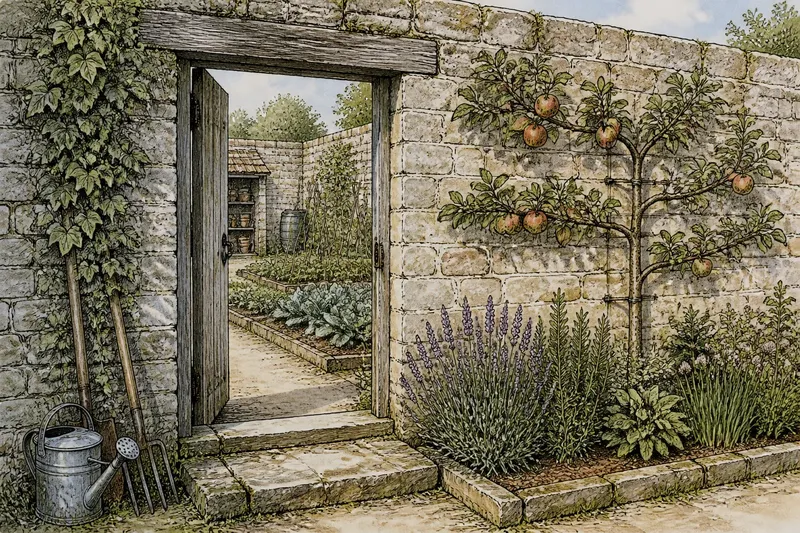
At an old garden wall, look first for the small door, the worn threshold, or the sheltered strip where herbs might once have grown. Walled garden history begins with these practical clues: an enclosure was not simply a backdrop for flowers, but a working room outdoors, shaped to protect plants and make daily tasks possible.
Walls as working shelter
A wall changes the conditions inside its boundary. It can soften wind, create a warmer pocket, and keep animals from reaching vegetables or fruit. For a household that depended on what it grew, these were useful qualities, not decorative extras.
Different sides of an enclosure could offer different growing conditions. A sunny wall might suit fruit trained against it, while a cooler, shaded edge could be useful for plants that wilted in strong sun. The effect depended on the site, the wall’s height and material, and the surrounding climate.
Read the wall as part of the garden’s growing equipment. A rough stone surface may hold warmth differently from a pale, smooth one, and a gap near the base may hint at drainage or access rather than neglect.
Food before display
Many enclosed gardens joined several kinds of work in one protected space. Vegetables, herbs, fruit trees, flowers for household use, and places to store tools could all belong within the same boundary. A neat division between “productive” and “ornamental” gardening is often too simple for older gardens.
Kitchen herbs could be close to a door because they were gathered often. Fruit trees might occupy an edge where branches could be trained, while beds for seasonal crops sat in open ground that was easier to cultivate. The arrangement followed use, access, light, and shelter more than a single visual scheme.
When interpreting an old garden, look for evidence of repeated work: narrow gates, worn paving near entrances, a water source, or a level patch where beds could have been maintained. Any one clue can have several explanations, but together they can suggest how people moved through the space.
Useful divisions
Enclosure did not always mean one uninterrupted lawn or a single planting bed. Low walls, hedges, fences, and partitions could separate crops, protect young plants, or keep a work area apart from a more orderly part of the garden.
A division could also help a household manage time. A small herb plot beside the kitchen was easy to reach in poor weather; a larger growing area could sit farther away. Gates and openings mattered because they connected these tasks without requiring people to cross every bed.
Imagine a household with a narrow walled plot, a door beside the kitchen, and a sunny stretch of masonry. They might keep frequently used herbs near the entrance, train a fruit tree along the warm wall, and leave the center open for vegetables; the visible result would be a garden organized around access and shelter, not a formal flower border.
What old walls reveal?
Why were gardens enclosed?
Walls helped shelter plants from wind and browsing animals, while making a defined area easier to manage. They could also give a household privacy and mark the garden as a space with its own routines.
What grew against a garden wall?
Fruit trees were often trained against walls where the local climate and growing conditions suited them, while herbs or other useful plants could occupy nearby ground. The exact planting depended on region, household needs, and the wall’s exposure.
How can I tell whether a wall was part of a garden?
Look for a combination of clues: a gate or threshold, a sheltered growing strip, old fixing points, or a layout that connects the wall to nearby buildings and water. A wall alone does not establish its original purpose, so treat these details as evidence to consider rather than proof.
Materials with a purpose
Stone, brick, earth, timber, and living hedges offered different kinds of boundary. Their availability varied by place, and each material shaped how much light, warmth, air, and maintenance the enclosure demanded. A hedge could be renewed through pruning, while masonry might provide a firmer edge and a surface for trained plants.
Repairs can be as informative as original construction. A patch of newer brick, a blocked opening, or a change in mortar may show that the garden’s needs shifted. Rather than treating every alteration as damage, ask what practical problem the change might have addressed.
For a home garden today, the lesson is not to copy an old wall regardless of site. A boundary can be a hedge, fence, trellis, or existing masonry, chosen for the shelter, privacy, and growing conditions the space actually needs.
Beyond the flower border
The familiar flower border is only one way to organize a garden, and it does not explain every older enclosed space. A productive garden could be orderly without making flowers its main purpose; paths, gates, water access, and work surfaces often mattered just as much.
That history offers a useful way to look at a garden wall now. Notice what it protects, what it makes easier to reach, and where its shelter changes the plants’ conditions. Walled garden history becomes most useful when it helps you see enclosure not as scenery, but as a quiet piece of growing infrastructure.
If you are preserving an old boundary, keep its openings and nearby ground legible before deciding what to plant. A clear threshold and an observed patch of sun can tell you more about the garden’s working character than a hurried new border.