The Focal-Point Myth: A Garden Can Have More Than One Star
A garden with more than one focal point can feel calm and connected. Learn how to share attention among plants, seating, containers, and small details.
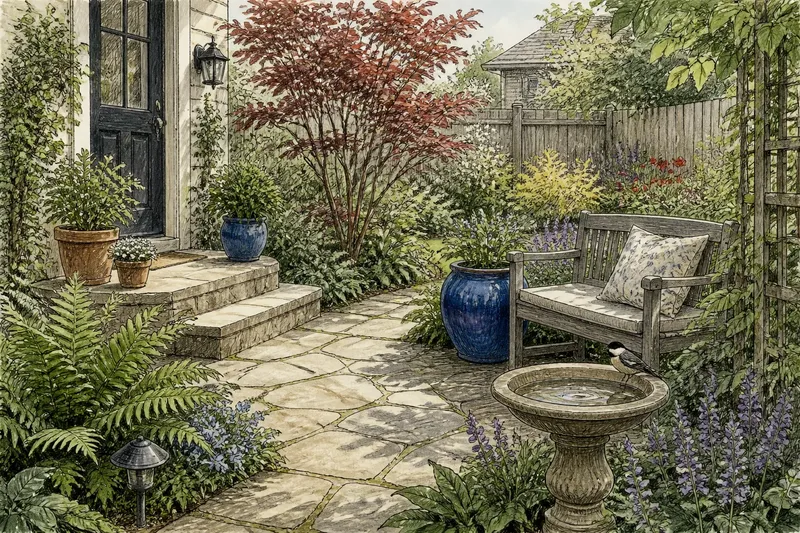
You step onto the patio with a cup of tea and notice the rust-red leaves of a Japanese maple, then a blue pot near the steps, then a bright patch of flowers at the fence. None is trying to outshine the others, yet each gives your eye a pleasant place to pause. A garden with more than one focal point can feel just as composed as one built around a single centerpiece.
The idea that every garden needs one dominant feature can make ordinary spaces feel like they are missing something. In a small yard, several modest points of interest may suit the way you actually use the space: a favorite plant by the door, a birdbath visible from the kitchen, or a bench softened by a climbing vine. The goal is not to make every corner loud. It is to give attention a few clear, related places to land.
Can a garden have several focal points?
Yes. A garden can have several focal points when they are distinct enough to notice and connected enough to belong together. A focal point does not have to be a sculpture or a dramatic specimen tree; it can be a useful object, a shift in plant texture, a container, or a small glimpse framed by foliage.
Think of these features as a conversation rather than a contest. A red-stemmed dogwood might catch the eye in one area, while a pale ceramic pot and a patch of ornamental grasses offer quieter interest elsewhere. Repeating a color, material, or plant shape helps the separate moments feel related without making them identical.
How many focal points should a small garden have?
There is no fixed number that suits every yard. Start with the places you already look toward: the view from the kitchen sink, the approach from the gate, and the spot where you sit. If each view has something worth noticing, you may not need to add another feature.
In a compact courtyard, a single large ornament can occupy more attention than the space can comfortably give it. A collection of smaller interests can feel more natural: a terracotta pot by the door, a fern beside a shaded seat, and a patch of fragrant herbs near the kitchen. Leave some areas visually quiet so these details have room to register.
How do several focal points avoid competing?
Give each feature a different kind of presence. A strong leaf color can be balanced by a simple shape, while a sculptural container can sit among restrained foliage. If several features share the same vivid color, large scale, and central position, they are more likely to pull against one another.
Spacing and sightlines matter, too. A focal point partly screened by a plant can feel like a discovery, while another placed openly near a seating area can serve as the main view from that seat. Avoid lining up every feature along one direct sightline; letting them appear from different positions gives the garden a more relaxed rhythm.
Say you have a narrow side yard with a blue glazed pot, a small bench, and a patch of golden foliage. Imagine moving the pot beside the bench, keeping the foliage visible from the doorway, and leaving the far end mostly green. The expected effect is a linked seating area, a separate bright accent, and a calmer view between them—not three objects demanding attention at once.
What can serve as a garden focal point?
Look for features that already matter to your daily experience, rather than shopping for a centerpiece simply to fill a gap. Useful choices often carry more charm than objects that have no connection to the rest of the garden.
- A distinctive plant, such as a fern with arching fronds or a shrub with colorful stems.
- A pot with a memorable glaze or shape, placed where its outline can be seen clearly.
- A bench, chair, or small table that makes a view feel intentional.
- A birdbath or shallow water bowl that brings movement and attracts visiting birds.
- A window box or herb container near a door, where scent and color reward regular use.
- A framed glimpse through foliage toward a gate, trellis, or neighboring tree.
Each choice works best when the surrounding plants make space for it. A finely textured plant may disappear among equally busy foliage, while a simple form can stand out against a softer background. Look at the feature from the places where you spend time, not only from the center of the garden.
Should focal points change with the seasons?
They can, and a garden with several modest points of interest is well suited to seasonal change. Spring bulbs might draw attention near a path, summer flowers may take over by the patio, and winter stems can become more noticeable when leafy growth fades. You do not need every feature to peak at the same time.
Choose a few elements that hold interest beyond their brief flowering period. Evergreen foliage, textured bark, seed heads, and weathered pots can keep a view engaging as the garden changes. Allow seasonal highlights to shift rather than trying to preserve one permanent star through every month.
How can I tell if the layout feels balanced?
Walk through the garden at its usual pace, then look from the windows and seats you use most. Notice whether one feature overwhelms the view, whether another is hidden by an overgrown plant, or whether your eye moves naturally among several points. A balanced layout does not have to look identical from every angle.
Try temporarily moving a lightweight pot or chair before changing established planting. If the view feels calmer with the object elsewhere, you have learned something useful without committing to a permanent alteration. Keep the features that support how you use the garden, and let background plants do the quieter work of connecting them.
A garden with more than one focal point can be personal without becoming crowded. Let one detail greet you at the door, another accompany a place to sit, and perhaps a third reward a closer look. The most satisfying arrangement may be the one that gives you something different to notice as you move through an ordinary day.